 how-to
Avoiding Hidden Fees When Buying Cars: 2026 Guide
Table of Contents
- Dealer Fees When Buying a Car: What's Mandatory vs. Negotiable
- How to Read a Buyer's Order Line by Line Before You Sign
- The Out-the-Door Price Car Buyers Should Demand in Writing
- Car Dealership Add-Ons: Which Ones to Keep and Which to Decline
- How to Negotiate Car Dealer Fees Without Blowing Up the Deal
- State Rules, Remote Purchases, and Financing Effects on Fees
- Conclusion
- Frequently Asked Questions
Last Updated: October 12, 2026
Dealer Fees When Buying a Car: What's Mandatory vs. Negotiable
The biggest mistake car buyers make is treating every line on the paperwork as fixed.
At Rusty Eck Ford, we've watched buyers save real money by knowing which is which before they sit down.
This guide breaks down mandatory government fees, negotiable dealer fees, the scripts to use at the desk, the out-the-door price, add-ons worth keeping, and how remote purchases change the math.
Government Fees You Can't Remove
These fees go to the state, not the dealer. No dealership can waive them, and any salesperson who claims otherwise is misleading you.
- Sales tax on the purchase price
- Title fee to transfer ownership
- Registration fee to plate the vehicle
Kansas sets these amounts, so the dealer simply collects and passes them along. The Kansas Department of Revenue vehicle registration guidance lists current rates and deadlines.
Verify every government fee on your buyer's order against official state sources. If a number looks high, ask for the breakdown.
Dealer-Added Fees You Can Challenge
Dealer fees when buying a car are where the real negotiation happens. These charges are set by the dealership, not the state, so most are negotiable.
Common examples include:
- Documentation fee (often called a doc fee)
- Dealer preparation or detail charges
- Advertising fee
A documentation fee covers title and registration paperwork; some states cap it, others don't. A market adjustment is an extra charge when demand outruns supply. Both are worth questioning.
How to Read a Buyer's Order Line by Line Before You Sign
The buyer's order is the most important document in the deal. It lists the vehicle price, every fee, your trade-in, and the final number you'll actually pay.
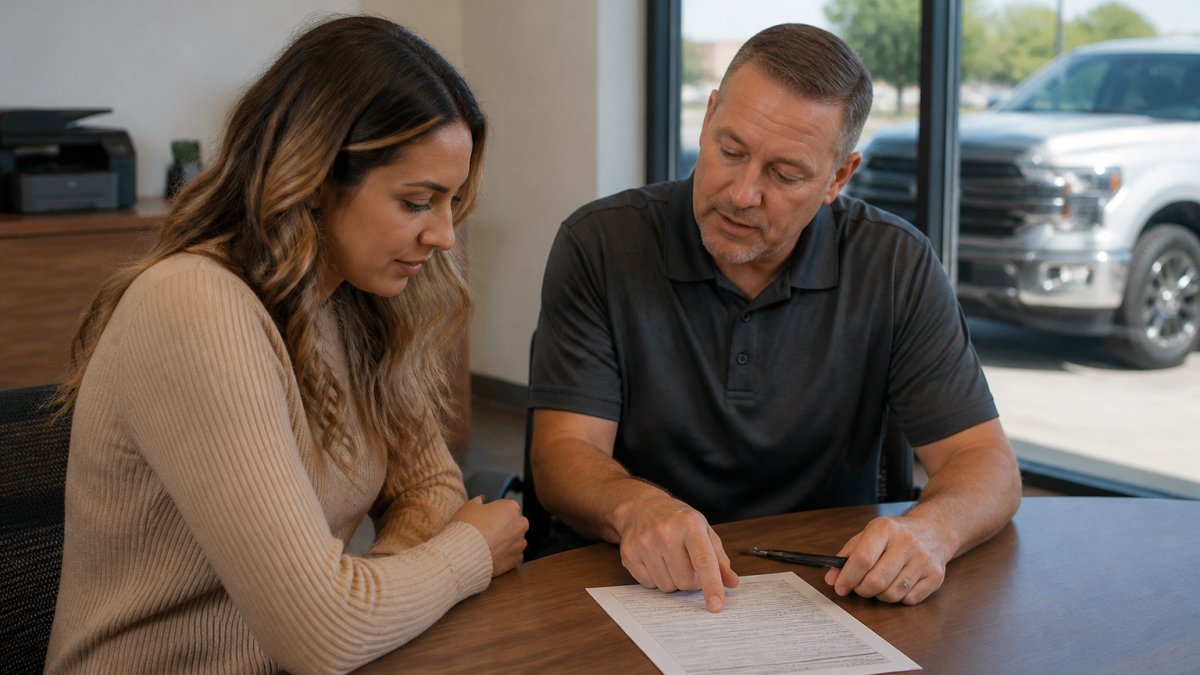
Read it slowly and check:
- Vehicle price vs. the sticker price or invoice price you agreed on
- Each fee listed separately, not bundled into one vague line
- Trade-in value matching your written offer
- Rebates and incentives applied correctly
- The out-the-door price at the bottom
If a line reads "miscellaneous" or "handling," ask what it covers. Vague labels hide unnecessary fees.
The Out-the-Door Price Car Buyers Should Demand in Writing
The out-the-door price is the total you pay to drive away: vehicle price, all fees, taxes, and add-ons combined. It is the only number that matters. Demand it in writing before you discuss financing; a dealer who won't provide it is worth walking away from.
Why Monthly Payment Talk Hides the Real Number
Monthly payment talk shifts focus away from total cost. A lower payment often means a longer loan and more interest: stretch a loan from 60 to 72 months and the payment drops, but the total cost climbs. Negotiate the out-the-door price first, then financing separately.
Car Dealership Add-Ons: Which Ones to Keep and Which to Decline
Add-ons are the quietest source of hidden cost in a car deal. They are not government fees, not required by your lender, and usually not required by the dealer. They are products, and products can be declined. Ask three questions of every line item:
- Is this required to complete the purchase or satisfy my lender?
- Does it duplicate coverage I already have through insurance, a factory warranty, or a credit card benefit?
- What is the total cost once financed, not just the monthly bump?
If question one is no and question two is yes, decline it. If question three surprises you, slow down.
New Versus Used: The Same Add-On Is Not the Same Decision
An add-on's value depends on the vehicle. A protection product on a new car with factory coverage is usually redundant; on a high-mileage used car it may overlap with a repair you already face.
| Add-On | New Car | Used Car | Why the Answer Changes |
|---|---|---|---|
| Extended warranty / service contract | Usually decline while factory coverage is active | Worth pricing if factory coverage has expired | You are buying coverage for a window you do not yet need on a new car, but you may be buying it for a window you are already in on a used one |
| Maintenance plan | Rarely worth it if the first services are included | Sometimes worth it on a car with unknown service history | New-car maintenance is often already bundled; used-car maintenance is a genuine unknown |
| Gap insurance | Consider if you finance with a small down payment | Consider if you are upside down on a trade | The risk is about loan-to-value, not vehicle age |
| Paint and fabric protection | Almost always decline | Almost always decline | Dealer-applied sealants rarely outperform a quality aftermarket application at a lower price |
| VIN etching | Decline | Decline | Provides negligible recovery benefit relative to cost |
| Tire-and-wheel protection | Situational, depends on wheel cost | Situational, depends on wheel cost | Low-profile or expensive wheels change the math; standard wheels usually do not |
| Key replacement coverage | Usually decline | Usually decline | Many auto policies and credit cards already include this |
What Each Add-On Actually Costs You
A $2,000 add-on is not a $2,000 decision when financed. Rolled into a 60-month loan at a typical new-car rate, you pay interest for the full term; over 72 months it costs more still. Ask the finance manager to show the add-on as a standalone cash price and as a financed amount. If the financed number is meaningfully higher, you are paying for the product twice.
The One Add-On Worth a Real Conversation
Gap insurance is the add-on most likely to be genuinely useful, covering the difference between what you owe and what the vehicle is worth if it is totaled or stolen. That gap is largest in the first year or two of a loan with a small down payment. Before buying it from the dealer, check whether your auto insurer offers it and whether your loan already includes it.
How to Decline Without Friction
You do not need a reason to decline an add-on. One sentence works: "I am declining all optional products today. Please remove them from the buyer's order." If the finance manager pushes back, repeat it; if pressure continues, ask for the out-the-door price without the add-ons in writing. A dealer who won't sell you the car without optional products is telling you something useful.
How to Negotiate Car Dealer Fees Without Blowing Up the Deal
How to negotiate car dealer fees comes down to timing and tone: vehicle price first, then fees, then financing. Never mix all three at once.
Try these lines at the desk:
- "Can you show me this fee on the state's official schedule?"
- "I'd like the doc fee removed from this deal. Can we do that?"
- "I'll sign today if the out-the-door price matches this number."
Stay calm and specific. Dealers expect negotiation on fees. What they don't expect is a buyer who has done the homework.
For extra use, get pre-approved financing before you arrive. A Consumer Financial Protection Bureau auto loan guide explains how pre-approval strengthens your position and helps you compare rates fairly.
State Rules, Remote Purchases, and Financing Effects on Fees
Most guides tell you to "check your state's rules" and stop there. Here is what actually varies, what does not, and how remote purchases and financing change the math.
What State Law Actually Controls
Three fee categories are governed at the state level, and the rules differ in ways that matter:
- Documentation fees. Some states cap the maximum a dealer may charge. Others require the fee to be disclosed but set no ceiling. A few require that the fee be charged uniformly to every customer, which means a dealer cannot waive it for you alone even if they wanted to. If you are in a capped state, the cap is your ceiling. If you are in an uncapped state, the fee is negotiable like any other dealer charge.
- Sales tax. Calculated on the purchase price, but the rate depends on your registered address, not the dealership's. This is why an out-of-state purchase can produce a tax number that looks wrong at first glance.
- Title and registration. Set by the state motor vehicle agency. These are pass-through costs. The dealer collects them and forwards them. They are not profit centers, and they are not negotiable.
Before you sign, ask the dealer to identify which lines on the buyer's order are government pass-throughs and which are dealer charges. A transparent dealer answers immediately; a vague answer is information.
Remote and Out-of-State Purchases
Buying from an out-of-state dealer introduces three costs a local deal does not:
- Delivery or transport fee. If the vehicle is shipped rather than driven, this is a real cost. Ask whether it is a pass-through from a transport company or a dealer markup, and get the carrier name in writing.
- Titling and registration in your home state. You will typically register the vehicle where you live, not where you bought it. That means your state's fees apply, and the dealer may or may not handle the paperwork.
- Sales tax handling. Some states collect tax at the point of sale and credit it against your home state's tax. Others require you to pay your home state directly. Getting this wrong can mean paying twice and waiting for a refund.
Before committing to a remote purchase, ask for a written out-the-door price separately listing vehicle price, delivery, documentation, and an estimate of your home-state tax and registration. If they cannot produce that, the deal is not ready.
How Financing Changes the True Cost of Fees
A fee is not just a fee. It is a fee plus interest, and the interest depends on how long you finance it. Consider a $1,500 bundle of dealer fees and add-ons rolled into the loan: over 60 months at a typical new-car rate, you pay interest on that $1,500 for five years, and stretching to 72 months grows it further even as the payment drops.
The practical implications:
- Negotiate fees before you discuss financing. Once a fee is in the loan, it is much harder to remove.
- Ask for the amount financed, not just the monthly payment. The amount financed is the number that includes every rolled-in fee and product.
- Compare the cash price and the financed price of every add-on. If they differ, you are paying interest on a product you may not need.
Pre-Owned Vehicles: Two Documents Worth Requesting
For a used car, request a vehicle history report and a written inspection summary before you sign. Neither is a guarantee, but together they give you a factual basis for the price you are agreeing to.
For pre-approval and rate comparison, the Consumer Financial Protection Bureau auto loan guide explains how pre-approval strengthens your position and helps you separate the vehicle negotiation from the financing negotiation.
Conclusion
Hidden fees can add hundreds to your final price, but they only work when buyers don't ask questions. Demand the out-the-door price in writing, sort mandatory government fees from negotiable dealer charges, and decline add-ons that duplicate coverage you already have.
At Rusty Eck Ford, we've built our process around transparency: a clear itemized price, competitive financing, and trade-in valuations you can trust.
Schedule a test drive with Rusty Eck Ford and see what an honest deal looks like from the start.
Frequently Asked Questions
What dealer fees are bogus and which ones do I actually have to pay?
Government charges like sales tax, title, and registration are mandatory and set by your state. Dealer-added items such as advertising fees, market adjustments, dealer preparation, and protection packages are not required by law and can be negotiated or removed. If a fee does not appear on your state's required list, treat it as optional until the dealer proves otherwise in writing.
Can you negotiate dealer fees when buying a car?
Yes, most dealer-added fees are negotiable, including documentation fees above your state's cap, advertising fees, and add-ons like paint protection or nitrogen tires. Ask for the itemized price breakdown, then negotiate the total out-the-door price rather than individual line items. Getting the number in writing before you sign gives you leverage and prevents last-minute additions.
What is included in a car's out-the-door price?
The out-the-door price covers the vehicle price plus sales tax, title and registration fees, documentation fees, destination charges, and any add-ons you agreed to. It is the final amount you pay before financing. Ask for this figure in writing on the buyer's order, and compare it to the sticker price so you can see exactly where each dollar goes.
How do you avoid add-ons you don't want at a dealership?
Tell the salesperson upfront that you want a written out-the-door price with no add-ons included. Review the buyer's order line by line and decline anything you did not request, such as extended warranties, protection packages, or maintenance plans. If a fee appears after you agreed on a price, ask for it to be removed or walk away.