 how-to
How to Inspect a Used Truck for Hidden Issues
Last Updated: November 2, 2026
Quick Summary
To inspect a used truck for hidden issues, start with the vehicle history report and maintenance records, then walk the frame, body panels, tires, and underbody for rust, damage, and fluid leaks. Test drive it on varied roads, and get a pre-purchase inspection before you sign. Each step catches problems a clean interior and fresh paint can hide.
- Review the vehicle history report and ask for maintenance records before inspecting the truck.
- Check the frame near suspension and hitch mounts for rust, cracks, or bends.
- Use a small magnet to test body panels for hidden body filler.
- Look underneath for fresh fluid drips, heavy exhaust rust, and damp differential areas.
- Schedule a pre-purchase inspection with a mechanic before signing any paperwork.
Table of Contents
- Why Hidden Issues Matter Before You Buy a Used Truck
- Step 1: Gather Your Tools and Review the Vehicle History
- Step 2: Walk Through the Used Truck Inspection Checklist
- Step 3: Check for Flood, Collision, and Odometer Red Flags
- Step 4: Run a Test Drive Checklist That Catches Drivetrain Problems
- Step 5: Get a Pre-Purchase Inspection for Used Trucks
- Deciding Whether to Negotiate, Walk Away, or Move Forward on Your Next Truck
- Frequently Asked Questions
Why Hidden Issues Matter Before You Buy a Used Truck
A used truck can look great on the lot and still hide expensive problems. Frame damage, flood history, and worn drivetrain parts are not always visible at first glance. See why Wichita drivers choose collision repair if you spot signs of past body work.
Most of the trouble comes from problems you cannot see from the driver's seat. A clean interior and fresh paint do not tell you how the truck was used or repaired.
Buyers in Wichita often use their trucks for towing, hauling, and daily commuting. Those jobs put real stress on a truck over time. Knowing what to look for helps you match a used truck to the work you actually need it to do.
Step 1: Gather Your Tools and Review the Vehicle History
Before you look at the truck itself, start with paperwork. A vehicle history report shows past owners, title records, accident reports, and service history.
Bring a few simple tools to the inspection:
- A flashlight, even during daylight, for checking under the truck
- A small magnet to test for hidden body filler
- A tire tread depth gauge
Ask the seller for maintenance records. Regular oil changes and documented repairs are a good sign. Gaps in service history are worth questioning.
Step 2: Walk Through the Used Truck Inspection Checklist
Walk around the truck slowly and work in a clear order. Starting at one corner and moving around the whole vehicle helps you miss less. On a truck, the order matters more than on a car because the expensive problems live underneath and at the ends where the work happens.
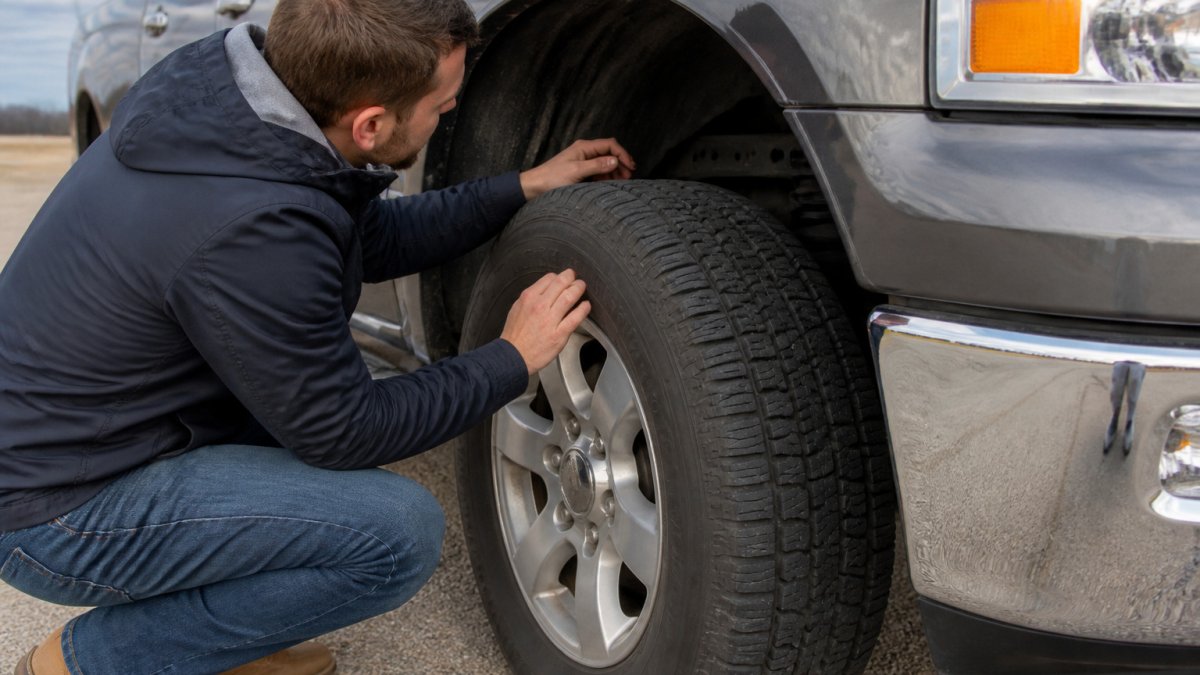
!A buyer in a casual jacket crouching beside a pickup truck's front wheel well, looking at the tire tread and frame rail in natural daylight
Frame, chassis, and body panels
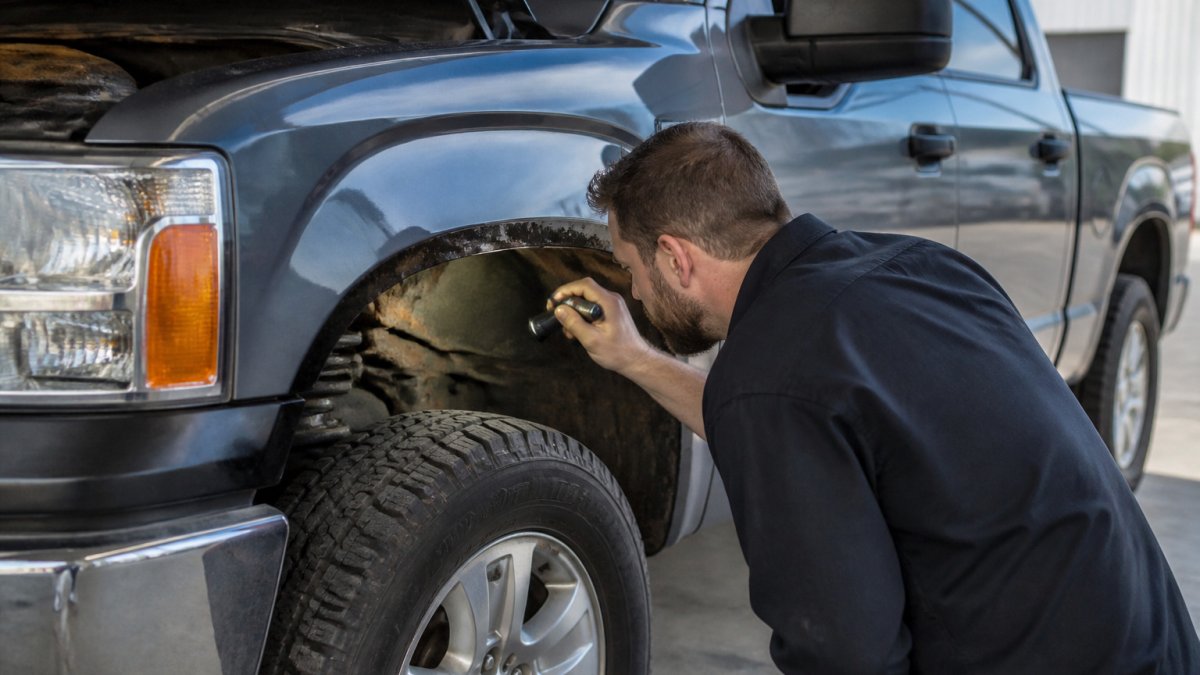
The frame is the backbone of any truck. Look underneath for rust, cracks, or bends, especially near the suspension mounts, body mounts, and where the hitch attaches. Pay close attention to the area behind the rear wheels and above the spare tire, where road spray collects.
Check the body panels for signs of past damage:
- Uneven gaps between the hood, doors, and fenders
- Mismatched paint color or texture between panels
- Dents, waves, or overspray on trim and rubber seals
Tires, underbody, and fluid leaks
Tires reveal a lot about how a truck was driven and maintained. Uneven tread wear can point to alignment or suspension issues. On a truck, also check that all four tires match in size, load rating, and brand.
Look under the truck for signs of trouble:
- Fresh oil or fluid drips on the ground or engine components
- Heavy rust on exhaust parts, brake lines, or the fuel tank
- Damp spots around the differential, transmission, or transfer case
Check the engine bay for signs of neglect or quick repairs, such as oily residue, mismatched hoses, or brand-new parts in an otherwise aged engine.
Truck-specific checks by configuration
A used truck's history shows up in different places depending on how it was built and used. Run these checks based on what you are looking at:
- 4WD and AWD trucks: Look at the front axle and CV boots for torn rubber and grease sling. Check that the transfer case shifts into 4-High and 4-Low smoothly, and listen for whining or clunking on a slow turn in 4WD on a loose surface. A truck that has never been off pavement still wears these parts, but mud and grit accelerate the damage.
- Towing-package trucks: Inspect the hitch receiver for elongation, cracks, or rust streaks around the bolt holes. Look at the trailer wiring connector for corrosion. Check the transmission and power-steering coolers for weeping lines.
- Diesel trucks: Look for soot streaks around the turbo and exhaust manifolds, check the coolant for oil sheen, and note whether the truck has a tuner or deleted emissions hardware. Ask for fuel-filter and oil-change records specifically.
What you can check yourself versus what needs a mechanic
A buyer can reasonably inspect frame rust, body panels, tires, fluid levels, and visible leaks.
If you want a baseline for what a well-kept truck looks like before you start comparing, you can browse used trucks near Wichita.
Here is a quick reference for the main areas to check on a used truck, and what to look for in each.
| Area | What to look for | Who should check it |
|---|---|---|
| Frame and chassis | Rust, cracks, or bends near suspension and hitch mounts | You, with a flashlight |
| Body panels | Uneven gaps, mismatched paint, magnet that won't stick | You, with a small magnet |
| Tires | Uneven tread wear, mismatched size or brand | You, with a tread gauge |
| Underbody | Fresh fluid drips, heavy exhaust or fuel tank rust | You |
| 4WD and AWD | Torn CV boots, smooth 4-High and 4-Low shifting | You, then a mechanic if unsure |
| Towing package | Hitch elongation, trailer wiring corrosion, cooler leaks | You |
| Diesel trucks | Soot streaks, oil sheen in coolant, fuel-filter records | You, plus a mechanic |
| Engine compression and transmission | Internal wear and hidden mechanical faults | Mechanic with a lift and scan tool |
Step 3: Check for Flood, Collision, and Odometer Red Flags
Some problems are harder to spot and require a closer look. Flood damage, salvage history, and odometer fraud are the three that cost buyers the most, and each leaves a different trail. This is where a truck-specific inspection earns its keep, because work trucks and fleet trucks are the most common victims of all three. Systematic verification of these hidden red flags requires a comprehensive inspection checklist to ensure that no mechanical or structural detail escapes your scrutiny.
Flood and water intrusion
Flood damage is one of the most serious hidden issues because it attacks wiring, connectors, and modules that are expensive to replace and hard to diagnose. Watch for these red flags:
- A musty smell or damp carpet under the floor mats, especially in the rear footwells
- Silt, rust, or corrosion on seat mounting bolts and wiring harnesses under the dash
- Fogging or water droplets inside the headlights and taillights
A truck that sat in deep water often shows clean carpet over dirty floor pans. Pull the door sill trim and look at the metal underneath, if it is cleaner than the carpet above it, ask why.
Collision and structural repair
Collision repair is not automatically a dealbreaker, but hidden structural work is. Look for:
- Wavy or rippled paint on the frame rails and inner fenders
- Weld marks, grinding scars, or fresh undercoating on the frame
- Mismatched bolts or hardware on the bed, cab, or front clip
A frame that has been straightened or welded is often a walk-away issue for buyers unless the repair is documented and the price reflects it.
Odometer and title discrepancies
Mileage tampering can happen on older trucks, so compare the odometer against other evidence. Compare the mileage on the dashboard with the history report, the oil-change stickers, and the wear on the pedals, seat bolsters, and steering wheel. A truck showing low miles with a worn-out driver's seat and a shiny brake pedal is worth questioning.
Check the title and the vehicle history report for:
- Branded titles (salvage, rebuilt, flood, lemon)
- Gaps in registration or long periods with no reported mileage
- A title that changed hands several times in a short window
Turning findings into a decision
Not every red flag means walk away. Sort what you find into three buckets:
- Walk-away issues: frame damage, flood history, branded title, odometer tampering, or a transmission that slips on the test drive. These are expensive, hard to prove, and hard to resell.
- Repairable defects: worn tires, a leaking differential cover, a cracked CV boot, or a failing brake line. These are normal used-truck wear and can be priced into an offer.
- Negotiation points: cosmetic damage, missing floor mats, a weak battery, or a check-engine light with a stored code you can read. These are leverage, not dealbreakers.
If you are unsure which bucket a finding belongs in, that is the moment to schedule a pre-purchase inspection rather than guess.
!A used pickup truck's front bumper and fender on a Wichita lot, showing panel alignment for collision signs
When you are ready to compare a truck you have inspected against clean inventory, you can explore the used car selection and look for examples with documented service history.
Step 4: Run a Test Drive Checklist That Catches Drivetrain Problems
A test drive shows you how the truck behaves under real conditions. Plan a route that includes city streets, a stop sign, and a highway stretch if possible.
During the drive, pay attention to these items:
- Smooth shifting with no hard jerks or slipping
- Steering that feels straight and does not pull to one side
- Brakes that stop the truck evenly without grinding or pulsing
Start the engine cold if you can. Listen for ticking, knocking, or squealing, and check that the warning lights clear after a few seconds.
Step 5: Get a Pre-Purchase Inspection for Used Trucks
Even a careful buyer benefits from a professional second opinion. A pre-purchase inspection by a qualified mechanic can find issues you would miss, such as worn internal engine parts or early frame rust.
Ask the mechanic to focus on:
- A full inspection report with photos and written notes
- Computer scan results, including any stored diagnostic trouble codes
- Estimated repair costs for anything that needs attention
Schedule the inspection before you sign any paperwork. A reputable seller should agree to it without pressure.
Deciding Whether to Negotiate, Walk Away, or Move Forward on Your Next Truck
Use what you found to make a clear decision. Minor cosmetic issues are often worth negotiating on. Frame damage, flood history, or a failing transmission usually justify walking away.
Keep a simple checklist for your decision:
- Negotiate when repairs are small and well understood
- Walk away when the truck has structural, flood, or major drivetrain problems
- Move forward when the inspection is clean and the history checks out
If you want to compare clean examples before you decide, you can browse used trucks near Wichita to see what a well-kept option looks like. When you are ready to see the used car selection, you can explore the used car selection.
Frequently Asked Questions
What should I check when inspecting a used truck?
Start with the frame and body, then move to tires, fluids, the engine bay, and the underbody. Look for rust or bends in the frame, uneven panel gaps, mismatched paint, and uneven tire wear. Check oil and coolant condition, look for fluid leaks under the truck, and confirm the transmission shifts smoothly. Bring a flashlight and a magnet to test for hidden body filler, and take notes so you can compare trucks side by side.
How can I tell if a used truck has hidden frame damage?
Look under the truck with a flashlight for kinks, bends, fresh welds, or new paint on the frame rails and crossmembers. Uneven gaps around the doors and hood can also point to a prior collision. If anything looks repaired or inconsistent, ask for a pre-purchase inspection from a qualified mechanic before you commit to the purchase.
Should I get a pre-purchase inspection before buying a used truck?
Yes. A pre-purchase inspection from an independent mechanic gives you a second set of eyes on the frame, drivetrain, and engine, and can reveal problems a test drive will not. Ask for a written inspection report and use any findings to negotiate the price or decide to walk away.
How do I check a used truck's maintenance and vehicle history?
Request the vehicle identification number (VIN) and review a vehicle history report, then compare it with the seller's maintenance records. Look for consistent service intervals, reported accidents, title brands, and mileage that matches the service history. Gaps or inconsistencies are a reason to ask more questions or request a mechanic's review before buying.